










 Giáo án lớp 1
 Giáo án lớp 2
 Giáo án lớp 3
 Giáo án lớp 4
 Giáo án lớp 5
 Giáo án lớp 6
 Giáo án lớp 7
 Giáo án lớp 10
 Giáo án lớp 11
Hỗ trợ tư vấn
Tư vấn - Giải đáp - Hỗ trợ đặt tài liệu
Mua gói Pro để tải file trên Download.vn (không bao gồm tài liệu cao cấp) và trải nghiệm website không quảng cáo
Tìm hiểu thêm »Giáo án Tiếng Anh 8 Friends Plus mang tới các bài soạn của 35 tuần trong năm 2025 - 2026. Qua đó, giúp thầy cô tiết kiệm khá nhiều thời gian, công sức trong quá trình xây dựng kế hoạch bài dạy môn Tiếng Anh 8 Friends Plus của mình.
Kế hoạch bài dạy Tiếng Anh 8 Friends Plus là tài liệu rất hữu ích, được biên soạn bám sát chương trình SGK giúp quý thầy cô tiết kiệm thời gian soạn giáo án cho riêng mình. Vậy sau đây là nội dung chi tiết giáo án Tiếng Anh 8 Friends Plus năm 2025 - 2026 mời các bạn tải tại đây. Ngoài ra quý thầy cô tham khảo thêm giáo án Công nghệ, Ngữ văn, Mĩ thuật.
Lưu ý: Giáo án Tiếng Anh 8 Friends Plus thiếu các bài Progress review 1, 2, 3, 4.
Week :...............
Period:.......................
STARTER UNIT
Lesson 1: Vocabulary: Routines
I can talk about routines and say when I do things.
I. OBJECTIVES
1. Knowledge: By the end of the lesson, students will be able to:
- understand how to describe their daily routines.
- use adverbs of frequency to describe their daily routines.
- understand how to use adverbs of frequency in a sentence.
- know how to ask their friends about their daily routines.
2. Skills: Speaking, listening, reading, writing.
3. Attitude: Students know how to learn English correctly.
4. Competence: Writing, self-learning capability, creative capacity, ability to use language……
II. PREPARATION:
1. Teacher: book, planning, TV
2. Students: books, notebooks
III. TEACHING METHODS
Communicative approach, group Ss and T’s activities, play as a character, teaching methods with games, teaching methods by visual, teaching methods by practicing, discussion group, technical present….
IV. PROCEDURE
1. Check–up: during the lesson
2. New lesson:
|
Teacher’s and Students’ activities |
Contents |
|
ACTIVITY 1: KNOWLEDGE FORMATION ❖ Aims: Help students pay attention to the content, and understand new vocabularies ❖ Products: Students’ answers ❖ Organization: Exercise 1: - Teacher explains the meaning of new words and gives some examples. - Teacher gives students time to think of answers. - Teacher invites students to answer questions in front of the class.
ACTIVITY 2: PRACTICE ❖ Aims: Help students understand how to use new words in exercise 1 to complete the dialogue and understand the meaning of dialogue ❖ Contents: Students work in particular ❖ Products: Students’ answer ❖ Organization Exercise 2: - Teacher gives students time to read the dialogue and complete answers - Teacher checks answers and invites students to answer questions in front of class Exercise 3: - Teacher gives students time to do the exercises. - Teacher invites some students to answer the exercise. - Teacher checks answers with the class. - Teacher gives students some new adverbs of frequency and explains the meaning. Exercise 4: - Teacher gives students time to work in pairs - Teacher suggests students some topics and questions. - Monitor while students are working and give general feedback at the end. - Teacher invites some students to speak in front of the class. Exercise 5 - Teacher gives students time to write a paragraph about their partner’s daily routine. - Teacher invites some students to speak their paragraphs and give feedback.
ACTIVITY 3. HOMEWORK - Learn by heart all the structures and new words. - Do exercises (in workbook). - Prepare new lesson. |
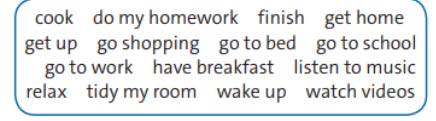
1. Study the words in the box. Which of these things do you do every day?
(Students’ own answers.) New words: - cook: nấu ăn - do my homework: làm bài tập về nhà - finish: kết thúc - get home: về nhà - get up: thức dậy - go shopping: đi mua sắm - go to bed: đi ngủ - go to school: đến trường - go to work: đi làm - have breakfast: đi ăn sáng - listen to music: nghe nhạc - relax: thư giãn - tidy my room: dọn phòng - wake up: tỉnh giấc - watch videos: xem video Suggested answers: - do my homework - get home - get up - listen to music - go to bed - go to school
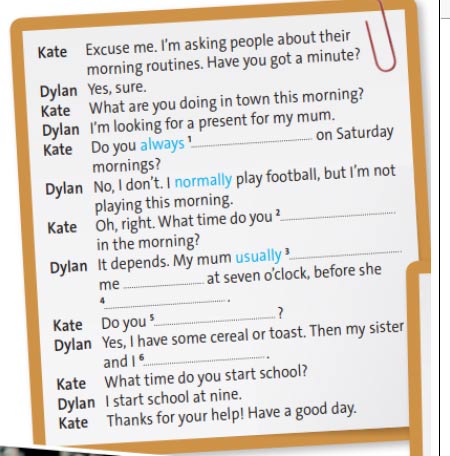
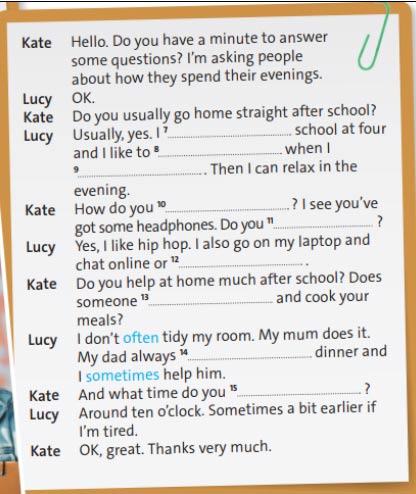
2. Complete the interviews using the correct form of the verbs in exercise 1. Then listen and check.
Suggested answers 1. go shopping 2. get up 3. wakes me up 4. goes to work 5. have breakfast 6. go to school 7. finish 8. do my homework 9. get home 10. relax 11. listen to music 12. watch videos 13. tidy your room 14. cooks 15. go to bed
3. Look at the words in blue in the dialogues in exercise 2. Where do adverbs of frequency go in a sentence? Think of more adverbs
(Students’ own answers.) New words: - always: luôn luôn - normally: thường thường - usually: thường thường - often: thường xuyên - sometimes: thỉnh thoảng
Suggested answers: - If a sentence has only one verb, place the adverb of frequency in the middle of the sentence. For example: Tom never flies. He always takes the bus. - When a sentence contains more than one verb, place the adverb of frequency before the main verb. For example: They have often visited Europe. - The adverb of frequency is placed after TO BE verb. For example: She is always happy, - The adverb of frequency is placed before a verb. For example: She always does her homework in the evening. - Other adverbs of frequency: + never: không bao giờ + seldom: hiếm khi + frequently: thường xuyên + occasionally: thỉnh thoảng + daily: hằng ngày Example: 1. We take a vacation at least once annually.. 2. We seldom see John. 3. My dentist told me I should floss twice daily.
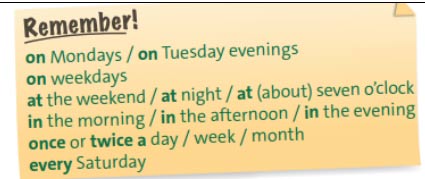
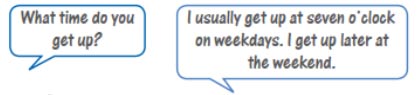
4. USE IT! Work in pairs. Ask and answer questions to compare your daily routines. Use time expressions, adverbs of frequency and the words and phrases in exercises 1 and 2. Are your routines similar?
(Students’ own answers.) Suggested answers: - Suggested topics: + After-school Activities + Weekend Activities + Before bed-time Activities + Everyday Favorites Activities - Suggested questions: + What time do you get home from school? + What time do you go to bed? + Do you go to the gym after school? + Do you watch television at night + What type of drink do you have every day? + How many times a day do you brush your teeth? 5. USE IT! Use the information about your partner in exercise 4 to write a paragraph about their daily routine Suggested answer: My friend’s name is Minh. She often gets up at 6 AM. Then, she brushes her teeth and has breakfast with her family. After that, she goes to school. She finishes school at 5 PM and gets home. In the evening, she does her homework. Then, she relaxes by listening to music and playing games. Finally, she goes to bed at 9 PM. |
|
|
*Feedback:............................................................................................................................
...............................................................................................................................................
...............................................................................................................................................
...............................................................................................................................................
Week :...... Date of preparing:.............
Period:/........ Date of teaching:...............
STARTER UNIT
Lesson 2: LANGUAGE FOCUS: Present simple and present continuous
I can talk about repeated and scheduled actions and things happening now.
I./. OBJECTIVES
1. Knowledge: By the end of the lesson, students will be able to:
- understand how to use present simple and present continuous
- use present simple and present continuous to answer questions
2. Skills: Speaking, listening, reading, writing.
3. Attitude: Students know how to learn English correctly.
4. Competence: Writing, self-learning capability, creative capacity, ability to use language……
II./. PREPARATION:
1. Teacher: book, planning, TV
2. Students: books, notebooks
III./. TEACHING METHODS
Communicative approach, group Ss and T’s activities, play as a character, teaching methods with games, teaching methods by visual, teaching methods by practicing, discussion group, technical present….
IV./.PROCEDURE
1. Check–up: during the lesson
2. New lesson:
|
Teacher’s Activities |
Students’ Activities |
Content |
|||
|
Warm Up |
|||||
|
-Refer students back to the interviews on
Ask: “What does Dylan usually do on
Write on the board: “He usually
Ask: “What is he doing in town
Write on the board: He’s looking
-Underline the verbs and elicit which verb is in the present simple and which is in the present continuous |
- Listen to the teacher. - In pairs, discuss the question.
- In pairs, complete the sentence.
- Look at the teacher and take notes.
|
“What does Dylan usually do on Saturdays?” “He usually plays football.” ð Present Simple
“What is he doing in town “He’s looking ð Present continuous
|
|||
|
Practice Aim: Students understand the grammar of present simple and present continuous, then do the exercise |
|||||
|
Exercise 1: - Teacher gives students time to think of answers. - Teacher invites students to answer questions in front of the class. - Teacher gives feedback and explains what students have not understood yet Exercise 2: - Teacher gives students time to complete answers -Remind students that we - Teacher checks answer and invites students to answer questions in front of class.
Exercise 3: - Teacher gives students time to do the exercises. - Teacher invites some students to answer the exercise. - Teacher checks answers with the class and gives feedback. - Teacher teaches new grammar about present simple and present continuous and give examples. Exercise 4: - Explain to students what consonant -Ask students to underline the consonant -Play the audio for students to - Teacher checks students’ answers. - Teacher invites some students to speak in front of the class and give general feedback at the end. Exercise 5 - Teacher gives students time to complete the conversation by using present simple and present continuous. - Teacher invites some students to answer questions and give feedback. Exercise 6 - Teacher gives students time to work in pairs and complete the exercise by using present simple and present continuous. -Allow students time to prepare their answers individually, then put them into pairs to ask and answer the questions. - Teacher invites some students to ask and answer questions in front of the class. - Teacher gives feedback. Exercise 7 - Teacher gives students time to work in pairs and complete the exercise by using present simple and present continuous. - Elicit a few possible questions that -Allow students time to write their - Teacher invites some students to ask and answer questions in front of the class. - Teacher gives feedback. GRAMMAR: * Present simple - To be: (+) S +IS/AM/ARE + ADJ/ N (-) S+ IS/AM/ARE + NOT + ADJ/N (?) IS/AM/ARE+ S + ADJ/N? Eg: (+) He is an engineer (-) He isn’t an engineer (?) Is he an engineer? - Regular verb: (+) S + V-S/ES (-) S+ DON’T/DOESN’T + V(BARE) (?) DO/DOES + S + V(BARE)? Eg: (+) I go to Japan ( -) I don’t go to Japan (?) Do you go to Japan? * Present continuous (+) S +AM/IS/ARE + V-ing (-) S+ AM/IS/ARE+NOT + V-ing (?) AM/IS/ARE + S + V-ing? FORM:
Eg.: (+) My mom is cleaning my room. (-) My mom isn’t cleaning my room. (?) Is your mother cleaning your room? |
-Students work in pairs to read the sentences and answer the questions.
-Read out each sentence and elicit the negative form.
-Students work in pairs to find the examples - Check answers with the class
-Listen and check answers with the class.
-Students read the gapped conversation and complete it with the correct verb forms. -Check answers with the class.
-Students work in pairs to match the halves
-Work in pairs |
Suggested Answers: Exercise 1: a Sentences 3
Suggested Answers: Exercise 2:
1 What aren’t you doing in town this
Suggested Answers: Exercise 3: 1 I’m not playing, I don’t (often) tidy Exercise 4: Suggested answers: break extra gift cold scholar history text discover planet
Consonant clusters in phonics can appear at the start of a word, for example: •/s/ /t/in stay •/f/ /r/in friend •/c/ /r/in croak Or at the end of a word: •/s/ /k/in task •/s/ /t/in fast •/n/ /t/in went •/n/ /d/in sound Exercise 5: Suggested answer: 1.I’m sitting 2. Do you want 3. I’m doing 4. Are you doing 5. I don’t usually do 6. They always finish late 7. Miss Maken does not usually check 8. She always checks 9. I’m not coming town Exercise 6: Suggested answers: 1-e 2-g 3-a 4-f 5-d 6-h 7-c 8-b
Exercise 7: Suggested answers: 1. What are your children doing right now? 2. Where does your father go? 3. Who are playing games with your sister? 4. Why are you doing homework now? 5. How often do you go swimming? 6. What time do you have lunch? When does your mother cook dinner?
|
|||
|
HOMEWORK - Learn by heart all the structures and new words. - Do exercises (in workbook). - Prepare new lesson |
|||||
.............
UNIT 1: FADS AND FASHIONS
Lesson 1: Vocabulary
Popular interests
I./. OBJECTIVES
1. Knowledge: By the end of the lesson, students will be able to:
- get some more knowledge about popular interests, activities and fashions
- develop students’ speaking and listening skills.
2. Skills: Speaking, listening, reading, writing.
3. Attitude: Students know how to learn English in right way.
4. Competence: Communication, self-learning capability, creative capacity, ability to use of language……
II./. PREPARATION:
1. Teacher: pictures, textbooks, PowerPoint slides, ….
2. Students: textbook, notebook.
III./. TEACHING METHODS: Communicative approach, group Ss and T’s activities, play as a character, teaching methods with game, teaching methods by visual, teaching methods by practicing, discussion group, technical present….
IV./.PROCEDURE:
1. Check – up : during the lesson
2. New lesson
|
Teacher’s and students’ activities |
Contents |
|
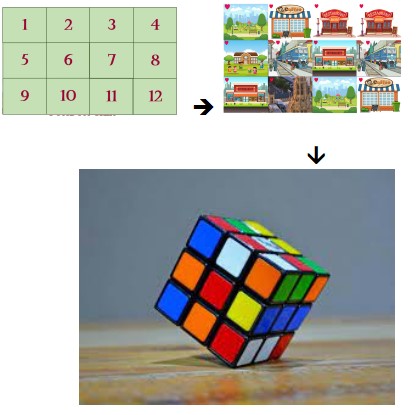
ACTIVITY 1: WARM-UP v Aims: Students can talk about popular interests, activities and fashions. v Contents: Students apply their knowledge to the situations, then work in groups to answer the questions. v Products: Students find out the clear picture behind the numbers. v Organization: - Teacher divides class into 2 groups. - There are 12 numbers about popular games, films, bands… on the screen. There is a hidden picture behind these numbers. Each group will choose a pair of number. With one correct pair, you will get 1 point. - The group has the most correct answers will be the winner. - After revealing the picture, teacher asks students a question: ? “What is the hidden picture about?” - Students answer “RUBIK’S CUBE” - Teacher calls out some students to answer the question. ? “What’s in fashion at the moment? What songs, films and games are popular?” - Students answer in their own. - Teacher leads in the new lesson.
ACTIVITY 2 : KNOWLEDGE FORMATION v Aims: Teacher presents new words related to popular interests, activities and fashions. v Contents: Students listen and repeat new words individual/pairs/groups. v Products: Students c an understand the meaning of new words. v Organization: - Teacher shows new words and uses some techniques of teaching vocabulary to teach them, then asks students to listen and repeat. - Students listen to the teacher and repeat the words. - Students copy down these words into their notebooks.
- Check -up : Matching
ACTIVITY 3: PRACTICE v Aims : S tudents can apply the knowledge which t hey have learnt to do the tasks given. v Contents: Students work in individual/pairs/groups to complete the tasks. v Products: Students’ answers v Organization Exercise 1: - Teacher gives students time to complete the task. (Students can discuss in groups, pairs or work individually). - Students listen and check their answers. Then answer the question “Which answer surprised you the most?” - Teacher checks students’ answers. Exercise 2: - Teacher plays the video or audio for Students to watch or listen and match the speakers with the topics - Students listen, match and answer the question.“Which speaker spends a lot of money on his / her interest?” - Teacher plays the video / audio again and checks students’ answers.
Exercise 3: -Teacher allows students time to read the gapped sentences. - Teacher plays the video / audio again for students to complete the sentences. -Teacher checks answers with the class.
Exercise 4:
- Teacher asks students to work in pairs and tell the class what your partner’s favourite interest is. - Teacher suggests some phrases to Ask and answer questions about the topics. ACTIVITY 4. PRODUCTION v Aims: Students can write a questionnaire for your class about their free time and interests. v Contents: Students work in groups. v Products: Student’s opinions v Organization: - Teacher asks students to work in groups and discuss about their free time and interests. - Teacher gives students time to discuss in group and write down their opinions. - Teacher calls out some students to present their opinion in front of class. ACTIVITY 5. HOMEWORK -Learn by heart all the new words. -Prepare for next lesson – Reading |
Game “GREEN BAMBOO”
The hidden picture is “RUBIK’S CUBE”
THINK! What’s in fashion at the moment? What songs, films and games are popular?
& New words - app (n) - craze (n) à crazy (adj) - fad (n) - follower (n) - gadget (n) - post (v,n) - social media (n)
1. Work with a partner and do the quiz. Suggested answers
1. b 2. b 3. a 4. a 5. a 6.a
- Students answer in their own.
2. Watch or listen to five people talking about their interests. Match the speakers with the topics. Which speaker spends a lot of money on his / her interest? Suggested answers: Max: sports Elizabeth: music Mitchell: fashion Yana: social media Joe: comics
Mitchell spends a lot of money on his interest.
3. Watch or listen again and complete the sentences. Suggested answers 1 .sports/ music 2. fashions 3. clothes 4. games 5. games 6. football
4. USE IT! Work in pairs. Ask and answer questions about the topics in exercise 3 using the key phrases. Tell the class what your partner’s favourite interest is.
Suggested answers - Do you spend much money on comics? - No. I’m not crazy about them. Are you into music? - …
Finish? Use the key phrases to write a questionnaire for your class about their free time and interests. Suggested answers - DIY - read comics - watch TV - music - sports - fashions - …
|
*Feedback:........................................................................................
Tải file tài liệu để xem thêm giáo án Tiếng Anh 8 Friends Plus
 Trịnh Thị Thanh
Theo Nghị định 147/2024/ND-CP, bạn cần xác thực tài khoản trước khi sử dụng tính năng này. Chúng tôi sẽ gửi mã xác thực qua SMS hoặc Zalo tới số điện thoại mà bạn nhập dưới đây: