










 Toán 10 Kết nối tri thức
 Toán 10 Chân trời sáng tạo
 Toán 10 Cánh Diều
 Soạn văn 10 Chân trời sáng tạo
 Soạn văn 10 Cánh Diều
 Soạn văn 10 Kết nối tri thức
 Tiếng Anh 10 Global Success
 Tiếng anh 10 Friends Global
 Tiếng Anh 10 Explore New Worlds
Hỗ trợ tư vấn
Tư vấn - Giải đáp - Hỗ trợ đặt tài liệu
Mua gói Pro để tải file trên Download.vn (không bao gồm tài liệu cao cấp) và trải nghiệm website không quảng cáo
Tìm hiểu thêm »Toán 10 Bài 9 Kết nối tri thức trang 58, 59 giúp các bạn học sinh có thêm nhiều gợi ý tham khảo để trả lời các câu hỏi phần luyện tập và 5 bài tập trong SGK bài Tích của một vectơ với một số thuộc chương 4 Vectơ.
Giải Toán 10 Kết nối tri thức Bài 9 trang 58, 59 được biên soạn với các lời giải chi tiết, đầy đủ và chính xác bám sát chương trình sách giáo khoa môn Toán 10 tập 1. Giải Toán 10 Bài 9 Kết nối tri thức là tài liệu cực kì hữu ích hỗ trợ các em học sinh lớp 10 trong quá trình giải bài tập. Đồng thời phụ huynh có thể sử dụng để hướng dẫn con em học tập và đổi mới phương pháp giải phù hợp hơn.
Cho tam giác ABC có trọng tâm G. Chứng minh rằng với điểm O tùy ý, ta có:
 \(\overrightarrow {OA} + \overrightarrow {OB} + \overrightarrow {OC} = 3.\overrightarrow {OG}\)
Gợi ý đáp án
Hình vẽ minh họa:
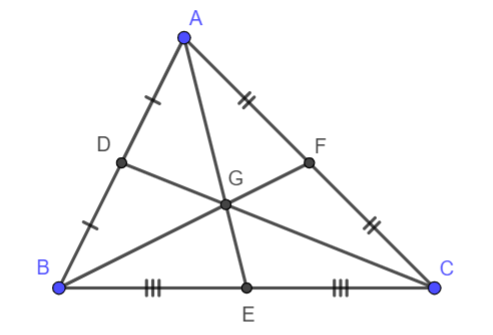
Ta có:
\(\begin{matrix}
\overrightarrow {OA} + \overrightarrow {OB} + \overrightarrow {OC} \hfill \\
= \overrightarrow {OG} + \overrightarrow {GA} + \overrightarrow {OG} + \overrightarrow {GB} + \overrightarrow {OG} + \overrightarrow {GC} \hfill \\
= 3\overrightarrow {OG} + \left( {\overrightarrow {GA} + \overrightarrow {GB} + \overrightarrow {GC} } \right) \hfill \\
\end{matrix}\)
Do G là trọng tâm tam giác ABC => \(\overrightarrow {GA} + \overrightarrow {GB} + \overrightarrow {GC} = \overrightarrow 0\)
=> \(\overrightarrow {OA} + \overrightarrow {OB} + \overrightarrow {OC} = 3.\overrightarrow {OG}\)
Trong hình 4.27, hãy biểu thị mỗi vecto \(\overrightarrow u ;\overrightarrow v\) theo hai vecto \(\overrightarrow a ;\overrightarrow b\) , tức là tìm các số x, y, z, t để \(\overrightarrow u = x.\overrightarrow a + y\overrightarrow b ;\overrightarrow v = t\overrightarrow a + z\overrightarrow b\)
Gợi ý đáp án
Hình vẽ minh họa:
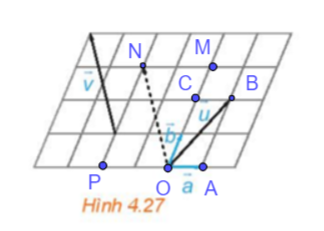
Xét hình bình hành OABC ta có:
\(\overrightarrow {OA} = \overrightarrow a ;\overrightarrow {OB} = 2\overrightarrow b ;\overrightarrow {OB} = \overrightarrow u\)
Khi đó ta có:
\(\overrightarrow u = \overrightarrow {OB} = \overrightarrow {OA} + \overrightarrow {OC} = \overrightarrow a + 2.\overrightarrow b\)(Quy tắc hình bình hành)
Xét hình bình hành OMNP ta có:
\(\overrightarrow {ON} = \overrightarrow v ;\overrightarrow {OM} = 3\overrightarrow b ;\overrightarrow {OP} = - 2\overrightarrow a\)
Khi đó ta có:
\(\overrightarrow v = \overrightarrow {ON} = \overrightarrow {OM} + \overrightarrow {OP} = 3\overrightarrow b - 2\overrightarrow a = - 2\overrightarrow a + 3\overrightarrow b\)
Vậy \(\overrightarrow u = \overrightarrow a + 2\overrightarrow b ;\overrightarrow v = - 2\overrightarrow a + 3\overrightarrow b\)
Cho hình bình hành ABCD. Gọi M là trung điểm của cạnh BC. Hãy biểu thị \(\overrightarrow {AM}\)theo hai vecto \(\overrightarrow {AB}\)và \(\overrightarrow {AD} .\)
Gợi ý đáp án
Học sinh tự vẽ hình
Từ M kẻ đường thẳng song song với AB, cắt AD tại E.
Khi đó tứ giác ABME là hình bình hành.
Do đó: \(\overrightarrow {AM} = \overrightarrow {AB} + \overrightarrow {AE} .\)
Dễ thấy: \(AE = BM = \frac{1}{2}BC = \frac{1}{2}AD\)
\(\Rightarrow \overrightarrow {AE} = \frac{1}{2}\overrightarrow {AD}\)
\(\Rightarrow \overrightarrow {AM} = \overrightarrow {AB} + \frac{1}{2}\overrightarrow {AD}\)
Vậy \(\overrightarrow {AM} = \overrightarrow {AB} + \frac{1}{2}\overrightarrow {AD}\)
Cho tứ giác ABCD. Gọi M, N tương ứng là trung điểm của các cạnh AB, CD. Chứng minh \(\overrightarrow {BC} + \overrightarrow {AD} = 2\overrightarrow {MN} = \;\overrightarrow {AC} + \overrightarrow {BD} .\)
Gợi ý đáp án
Ta có:
\(\overrightarrow {MN} = \overrightarrow {MA} + \overrightarrow {AD} + \overrightarrow {DN}\)
Mặt khác: \(\overrightarrow {MN} = \overrightarrow {MB} + \overrightarrow {BC} + \overrightarrow {CN}\)
\(\begin{array}{l} \Rightarrow 2\overrightarrow {MN} = \overrightarrow {MA} + \overrightarrow {AD} + \overrightarrow {DN} + \overrightarrow {MB} + \overrightarrow {BC} + \overrightarrow {CN} \\ \Leftrightarrow 2\overrightarrow {MN} = \left( {\overrightarrow {MA} + \overrightarrow {MB} } \right) + \left( {\overrightarrow {DN} + \overrightarrow {CN} } \right) + \overrightarrow {BC} + \overrightarrow {AD} \\ \Leftrightarrow 2\overrightarrow {MN} = \overrightarrow 0 + \overrightarrow 0 + \overrightarrow {BC} + \overrightarrow {AD} \\ \Leftrightarrow 2\overrightarrow {MN} = \overrightarrow {BC} + \overrightarrow {AD} \end{array}\)
Tương tự ta cũng có:
\(\left\{ \begin{array}{l}\overrightarrow {MN} = \overrightarrow {MA} + \overrightarrow {AC} + \overrightarrow {CN} \\\overrightarrow {MN} = \overrightarrow {MB} + \overrightarrow {BD} + \overrightarrow {DN} \end{array} \right.\)
\(\begin{array}{l} \Rightarrow 2\overrightarrow {MN} = \overrightarrow {MA} + \overrightarrow {AC} + \overrightarrow {CN} + \overrightarrow {MB} + \overrightarrow {BD} + \overrightarrow {DN} \\ \Leftrightarrow 2\overrightarrow {MN} = \left( {\overrightarrow {MA} + \overrightarrow {MB} } \right) + \left( {\overrightarrow {CN} + \overrightarrow {DN} } \right) + \overrightarrow {AC} + \overrightarrow {BD} \\ \Leftrightarrow 2\overrightarrow {MN} = \overrightarrow 0 + \overrightarrow 0 + \overrightarrow {AC} + \overrightarrow {BD} \\ \Leftrightarrow 2\overrightarrow {MN} = \overrightarrow {AC} + \overrightarrow {BD} \end{array}\)
Vậy \(\overrightarrow {BC} + \overrightarrow {AD} = 2\overrightarrow {MN} = \;\overrightarrow {AC} + \overrightarrow {BD} .\)
Cho hai điểm phân biệt A và B.
a) Hãy xác định điểm K sao cho \(\overrightarrow {KA} + 2\overrightarrow {KB} = \overrightarrow 0 .\)
b) Chứng minh rằng với mọi điểm O, ta có \(\overrightarrow {OK} = \frac{1}{3}\overrightarrow {OA} + \frac{2}{3}\overrightarrow {OB} .\)
Gợi ý đáp án
a)
Ta có: \(\overrightarrow {KA} + 2\overrightarrow {KB} = \overrightarrow 0 .\)
\(\Leftrightarrow \overrightarrow {KA} = - 2\overrightarrow {KB}\)
Suy ra vectơ \(\overrightarrow {KA} và vecto\;\overrightarrow {KB}\) cùng phương, ngược chiều và KA = 2.KB
\Rightarrow K,A,Bthẳng hàng, K nằm giữa A và B thỏa mãn: KA = 2.KB
Cho tam giác ABC
a) Hãy xác định điểm M để \(\overrightarrow {MA} + \overrightarrow {MB} + 2\overrightarrow {MC} = \overrightarrow 0\)
b) Chứng minh rằng với mọi điểm O, ta có \(\overrightarrow {OA} + \overrightarrow {OB} + 2\overrightarrow {OC} = 4\overrightarrow {OM}\)
Gợi ý đáp án
a) Ta có:
\(\overrightarrow {MA} + \overrightarrow {MB} + 2\overrightarrow {MC} = \overrightarrow 0 \Leftrightarrow \overrightarrow {MA} + \left( {\overrightarrow {MA} + \overrightarrow {AB} } \right) + 2\left( {\overrightarrow {MA} + \overrightarrow {AC} } \right) = \overrightarrow 0\)
\(\begin{array}{l} \Leftrightarrow \overrightarrow {MA} + \left( {\overrightarrow {MA} + \overrightarrow {AB} } \right) + 2\left( {\overrightarrow {MA} + \overrightarrow {AC} } \right) = \overrightarrow 0 \\ \Leftrightarrow 4\overrightarrow {MA} + \overrightarrow {AB} + 2\overrightarrow {AC} = \overrightarrow 0 \\ \Leftrightarrow 4\overrightarrow {AM} = \overrightarrow {AB} + 2\overrightarrow {AC} \\ \Leftrightarrow \overrightarrow {AM} = \frac{1}{4}\overrightarrow {AB} + \frac{1}{2}\overrightarrow {AC} \end{array}\)
Trên cạnh AB, AC lấy điểm D, E sao cho \(AD = \frac{1}{4}AB;\;\,AE = \frac{1}{2}AC\)
Khi đó \(\overrightarrow {AM} = \overrightarrow {AD} + \overrightarrow {AE}\)hay M là đỉnh thứ tư của hình bình hành AEMD.
Chất điểm A chịu tác động của ba lực \(\overrightarrow {{F_1}} ,\;\overrightarrow {{F_2}} ,\;\overrightarrow {{F_3}}\) như hình 4.30 và ở trạng thái cân bằng (tức là \(\overrightarrow {{F_1}} + \;\overrightarrow {{F_2}} + \;\overrightarrow {{F_3}} = \overrightarrow 0 )\). Tính độ lớn của các lực \(\overrightarrow {{F_2}} ,\;\overrightarrow {{F_3}} biết \overrightarrow {{F_1}}\) có độ lớn là 20N.
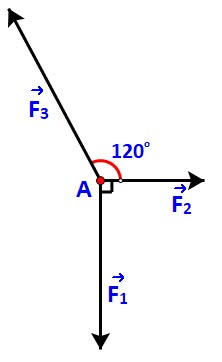
Gợi ý đáp án
Bước 1: Đặt \(\overrightarrow u = \overrightarrow {{F_1}} + \;\overrightarrow {{F_2}}\). Ta xác định các điểm như hình dưới.
Dễ dàng xác định điểm C, là điểm thứ tư của hình bình hành ABCD. Do đó vecto \(\overrightarrow u\) chính là vectơ \(\overrightarrow {AC}\)
Vì chất điểm A ở trang thái cân bằng nên \(\overrightarrow {{F_1}} + \;\overrightarrow {{F_2}} + \;\overrightarrow {{F_3}} = \overrightarrow 0\)hay \(\;\overrightarrow u + \;\overrightarrow {{F_3}} = \overrightarrow 0\)
\(\Leftrightarrow \;\overrightarrow u và \;\overrightarrow {{F_3}}\) là hai vecto đối nhau.
\(\Leftrightarrow A\) là trung điểm của EC.
Bước 2:
Ta có:\(\left| {\overrightarrow {{F_1}} } \right| = AD = 20,\;\left| {\overrightarrow {{F_2}} } \right| = AB,\;\left| {\overrightarrow {{F_3}} } \right| = AC.\)
Do A, C, E thẳng hàng nên \(\widehat {CAB} = {180^o} - \widehat {EAB} = {60^o}\)
\(\begin{array}{l} \Rightarrow \widehat {CAD} = {90^o} - {60^o} = {30^o}\\ \Rightarrow \left\{ \begin{array}{l}AC = \frac{{AD}}{{\cos {{30}^o}}} = \frac{{40\sqrt 3 }}{3};\;\\AB = DC = AC.\sin {30^o} = \frac{{20\sqrt 3 }}{3}.\end{array} \right.\end{array}\)
Vậy \(\;\left| {\overrightarrow {{F_2}} } \right| = \frac{{20\sqrt 3 }}{3},\;\;\left| {\overrightarrow {{F_3}} } \right| = \frac{{40\sqrt 3 }}{3}.\)
1. Tích của vecto với một số
+) Tích của một vecto \(\overrightarrow a \ne \overrightarrow 0\)với một số thực k là một vecto, kí kiệu là \(k\overrightarrow a\).
+) Vecto \(k\overrightarrow a\)có độ dài bằng \(\left| k \right|\left| {\overrightarrow a } \right|\) và
Cùng hướng với vecto \(\overrightarrow a\)nếu k > 0
Ngược hướng với vecto \(\overrightarrow a\)nếu k < 0
+) Quy ước: \(k\overrightarrow a = \overrightarrow 0 \Leftrightarrow \left[ \begin{array}{l}\overrightarrow a = \overrightarrow 0 \\k = 0\end{array} \right.\)
Nhận xét: Hai vecto \(\overrightarrow a\)và \(\overrightarrow b\)cùng phương khi và chỉ khi tồn tại k để \(\overrightarrow a = k\overrightarrow b .\)
2. Các tính chất của phép nhân vecto với 1 số
+) Với hai vecto \(\overrightarrow a ,\overrightarrow b\)và hai số thực k,t ta luôn có:
\(\begin{array}{l}k(t\overrightarrow a ) = (kt)\;\overrightarrow a k + t)\,\overrightarrow a = k\overrightarrow a + t\overrightarrow a \\k(\overrightarrow a + \overrightarrow b ) = k\overrightarrow a + k\overrightarrow b ;\quad k(\overrightarrow a - \overrightarrow b ) = k\overrightarrow a - k\overrightarrow b \\1\;\overrightarrow a = \overrightarrow a ;\;\;( - 1)\;\overrightarrow a = - \,\overrightarrow a \end{array}\)
+) Nhận xét:
I là trung điểm của \(AB \Leftrightarrow \overrightarrow {IA} + \overrightarrow {IB} = \overrightarrow 0\)
G là trọng tâm \(\Delta ABC \Leftrightarrow \overrightarrow {GA} + \overrightarrow {GB} + \overrightarrow {GC} = \overrightarrow 0\)
 Trịnh Thị Thanh
Theo Nghị định 147/2024/ND-CP, bạn cần xác thực tài khoản trước khi sử dụng tính năng này. Chúng tôi sẽ gửi mã xác thực qua SMS hoặc Zalo tới số điện thoại mà bạn nhập dưới đây: